Machine Guarding Essentials: What You Need to Know
Every year, machine-related hazards remain one of OSHA’s most frequently cited violations under 29 CFR 1910 Subpart O, particularly 1910.212. And in most cases, the problem isn’t complicated engineering failures. It’s the basics, including missing fixed guards, bypassed interlocks, or light curtains that don’t work.
OSHA Machine Guarding Requirements
Under 1910.212, employers must protect employees from hazards such as:
Point of operation exposure
Ingoing nip points
Rotating parts
Flying chips and sparks
OSHA doesn’t tell you exactly how to guard every machine, but it does require that exposure to dangerous moving parts be effectively controlled.
Point-of-Operation Protection
The point of operation, where the work actually happens, is one of the most cited areas in manufacturing facilities.
Common issues include:
Guards were removed
Inadequate protection during setup or clearing a jam
Overreliance on policies instead of physical barriers
Old machines that never had point-of-operation guards
Ways to guard the point-of-operation include:
Light Curtains
Interlocked doors
Two-hand controls (for 1 operator only)
Light scanners
Adjustable guards to the size of the stock
Interlocking clear shields, such as guards that can go on lathes or drill presses
OSHA Machine Guard Design Requirements
Under 1910.212(a)(2), guards must:
Prevent employee contact with hazardous moving parts
Be securely fastened and durable
Not create new hazards (such as sharp edges or pinch points)
Protect against falling objects
Not interfere unnecessarily with machine operation
Allow safe lubrication without removing the guard, when possible
Machine Guarding vs. Lockout/Tagout
Machine guarding protects employees during normal operations.
Lockout/Tagout (1910.147) protects employees during servicing and maintenance.
Moving Beyond Machine Guarding Minimum Compliance
OSHA sets the minimum standard - not the benchmark for excellence.
High-performing manufacturing organizations:
Perform daily machine guarding inspections by operators
Conduct machine guarding assessments to identify any machine guarding issues
Add deficiencies to a corrective action log and work to add the required guards
Track machine-related near misses, not just injuries
Effective guarding is not just about avoiding citations; it’s about protecting your workforce, maintaining uptime, and reducing liability.
How Triangle Safety Consulting LLC Can Help
At Triangle Safety Consulting LLC, we partner with manufacturers to perform comprehensive Machine Guarding Assessments aligned with OSHA 1910 Subpart O and ANSI B11 risk reduction principles.
As B11 Licensed Machine Safety Specialists (LMSS), we provide structured, practical evaluations that:
Identify exposure at points of operation and power transmission components
Assess guarding effectiveness
Align recommendations with OSHA and ANSI B11 standards
Provide guarding ideas to safeguard the unsafe area
Our goal is simple: help you reduce risk, strengthen compliance, and protect your people without disrupting production.
If you’d like a machine guarding assessment, please get in touch with us.
Machine guarding done right protects more than compliance; it protects hands, limbs, and lives!
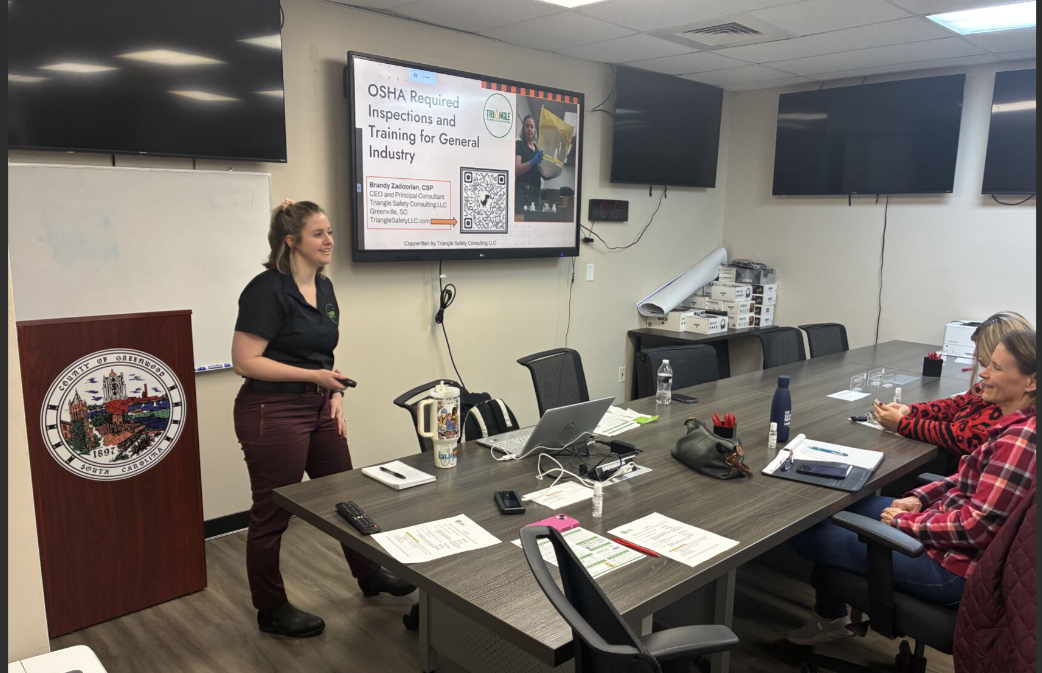
This blog was written by Brandy Zadoorian, CSP, and Triangle Safety Consulting LLC's Owner and Principal Consultant. She offers audits, expertise, resources, and guidance to help manufacturing facilities improve compliance with OSHA Requirements, minimize injuries and illnesses, and reduce risk!
She is a Certified Safety Professional (CSP) under the Board of Certified Safety Professionals.